
Protected Fatty Acids for Poultry and Game Birds
A Practical Guide for Farmers, Rearers and Gamekeepers
Protected (encapsulated) fatty acids are a new generation of gut‑health tools designed to support stronger chicks, cleaner guts, better performance, and reduced disease pressure. They work by delivering natural medium‑chain fatty acids directly to the lower gut, where most harmful bacteria live. Encapsulation ensures they survive the upper gut and release exactly where they are needed. Our C4A product presents the protected fatty acids as a liquid for dilution in the drinking water at 600ml per 1000 litres. In C4A, the method used to protect the fatty acids is unique in that it uses glycerol to combine with four fatty acids to make fat molecules, which are the emulsified to creat a water-mixable liquid for easy and quick use.
Why Protected Fatty Acids Matter
Stronger, Healthier Chicks
-
Better early gut development
-
Improved resilience during brooding
-
Lower early‑life mortality
-
More uniform growth
Natural Pathogen Control
Protected fatty acids have proven activity against:
-
E. coli
-
Clostridium perfringens
-
Salmonella
-
Campylobacter
This helps reduce scour, wet litter, and enteritis, especially in high‑pressure systems.
Better Feed Hygiene
Encapsulated fatty acids help keep feed clean and reduce bacterial load, supporting:
-
Breeder egg hygiene
-
Chick viability
-
Lower pathogen carry‑over
Improved Performance
Farmers typically report:
-
Better feed conversion
-
More consistent growth
-
Reduced medication use
-
Improved feathering and condition
Works Alongside Existing Programmes
Protected fatty acids complement:
-
Coccidiosis control
-
Probiotics
-
Organic acids
-
Vaccination programmes
-
Biosecurity measures
They are not a replacement; they strengthen the whole system.
How Protected Fatty Acids Work
Text‑based diagram for easy use in blogs or print.
HOW PROTECTED FATTY ACIDS WORK
-
FEEDING Bird drinks water containing protected fatty acids.
-
PROTECTION Encapsulation prevents the fatty acids being absorbed too early in the crop, proventriculus and gizzard.
-
TARGETED RELEASE The coating breaks down in the small intestine and caeca, releasing active fatty acids exactly where pathogens live.
-
ACTION Fatty acids disrupt harmful bacteria by breaking down their cell membranes. This is a natural, non‑antibiotic mode of action.
-
RESULTS ON FARM
-
Cleaner gut
-
Better nutrient absorption
-
Stronger immunity
-
Drier litter
-
Healthier, more uniform birds
Species‑Specific Benefits
Broilers
-
Faster early gut development
-
Reduced early mortality
-
Lower Clostridium and E. coli pressure
-
Improved feed conversion and uniformity
Layers and Breeders
-
Better egg hygiene
-
Reduced bacterial load on eggshells
-
Stronger chicks with improved early immunity
Turkeys
-
Lower enteritis risk
-
Improved poult viability
-
Better litter quality
Ducks and Waterfowl
-
Reduced wet‑litter problems
-
More stable gut under stress
-
Better feathering and growth consistency
Game Birds (Pheasant, Partridge, Quail)
-
Stronger chicks in the first 14 days
-
Lower disease pressure in brooding and release pens
-
Reduced piling, stress and gut upsets
-
Improved survival to release
What Farmers Typically Notice
-
Chicks get away better
-
Fewer digestive upsets
-
Birds stay cleaner and more settled
-
Less variability in pens
-
Lower reliance on antibiotics
-
Better overall flock health
Frequently Asked Questions
Are they antibiotics? No. They are natural fatty acids found in coconut and palm oils, delivered in a protected form.
Do they replace coccidiosis control? No. They support it by improving gut integrity.
Are they safe for all ages? Yes. They are especially valuable in the first two to three weeks of life.
Do they affect taste or smell of feed? Encapsulation removes odour and improves palatability.
Related Products
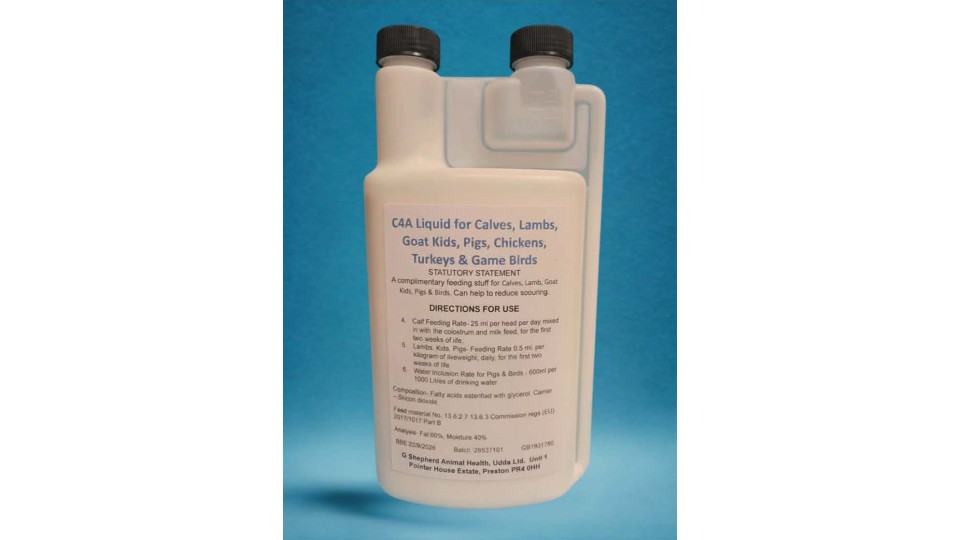
C4A Liquid - Gut microbiome enhancer
C4A stands for "Care 4 Animals". C4A liquid is added to liquid feed or drinking water to improve ..
£30.00 £30.00
You might also like
Are we feeding live Johnes disease / MAP in calf milk replacer?
Are we feeding live Johnes / Mycobacterium avium subsp. paratuberculosis in calf milk replacer? S...Read more

SHEPHERD AGRI invests in dairy hygiene with new appointment
Better dairy hygiene products and advice can help farmers to boost animal health and productivity, a...Read more

Study shows heat-treated colostrum performs better
A study recently published in the Journal of Dairy Science showed that heat-treating colostrum suppo...Read more

Pasteurising milk and colostrum reduces calf scours
Pasteurising milk and colostrum for calf feeding is becoming more popular in the UK. ...Read more